
 14 november 2015
Apparently there is a need for a disclaimer here. This blog is not about the results of the study referred to below, but rather about the premise stated in the “Theoretical framework and explication of the research questions” of the report, namely the competency iceberg and its relation to the importance of certain types of learning.
A few days ago I received a notice about a report on teaching students in the lower levels of vocational education, blinked a couple of times and then checked whether the notification was real or whether it came from The Onion, or in this case – as the report was Dutch – from De Speld. Why? Because of the following illustration and its explanation.
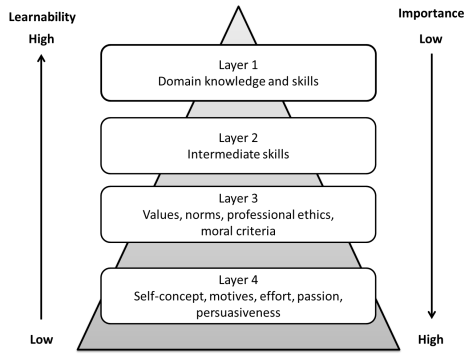
Learnability and importance of competencies and personal characteristics from the iceberg structure [Report – Translated by me]
The research was meant to answer questions regarding the competencies that teachers need to have and develop in order to do a good job teaching at the lower levels of vocational education. I have always learned and taught that, regardless of the rest of a piece of research (that is its methodology, data analysis, etc.), he basis is its theoretical foundation. The report’s authors state in their introduction that the theoretical foundation underlying their research is what they call the competency iceberg. As far as I have been able to discern, the competency iceberg holds that “a competency has some components which are visible like knowledge and skills but other behavioural components like attitude, traits, thinking styles, self-image, organizational fit etc [which] are hidden or beneath the surface”. The authors add two things to what I have found about this model.
First, they add that deeper lying personal characteristics –I myself prefer the term higher order – are on the one hand essential for functioning in one’s chosen vocation or profession, but are hard to learn and train. [Note: I really don’t understand the authors’ use of “but” since the preposition “but” signals that something contrasting with what has already been mentioned is being introduced and this is not the case here]. Other than the use of “but”, there’s not a cloud in the sky nor on the horizon. Indeed, such things are really hard to convey as a teacher, let alone acquire as a learner.
The authors then add a second feature to the iceberg, namely that such domain knowledge and skills are relatively easier to teach than the personal characteristics [still no problem], but are less important for a professional for carrying out a task. And this is where the sky filled with storm clouds and I had to blink twice as I really couldn’t believe my eyes.
How can the knowledge and skills that are required to understand and carry out a task be less important than what follows (i.e., what lies under the surface of the water)? Do the authors really mean this? Do they mean that they would want to go to a mechanic, plumber, doctor, or whatever professional you can think of who is highly motivated, persuasive, passionate and so forth, but who knows very little about her/his professional domain and doesn’t have the skills to work on their car, pipes, bodies or whatever? And since their research is about teachers in the lower levels of vocational education, does this mean tit isn’t important that these teachers are competent in the subject areas that they are teaching, just as long as they have good self-concepts of themselves and are motivated, persuasive, effortful, and passionate?
In any event, I don’t, and I hope not, especially for the students they teach!
Let’s stop with such absurd dichotomies! Yes, one is harder to achieve than the other. But saying that one is less important than the other, especially that which is at the foundation of the rest, is like building a house on (quick)sand. It’s just going to sink in.
Please reblog, tweet or post
…and Follow me on Twitter @P_A_Kirschner


 Blogcollectief Onderzoek Onderwijs
Dit is op From experience to meaning… herblogden reageerde:
Paul is pretty upset, and I understand why…
LikeLike
Hi Paul,
From what I understand from reading the original (Dutch) research that you link to, the authors use the model much more specific and limited than you do.
Their research focuses on the competencies needed by teachers in the lower levels of vocational education to build a strong interpersonal relationship with the students.
They chose this focus because of previous research by Lesterhuis (2010) that indicated that “interpersonal relationships between teachers and students” at this level was important.
They define interpersonal relationships as the personal working relationship between teacher and student aimed at the cognitive and social emotional development of the student. The assumption of the authors is that a good interpersonal relationship is a requirement for involvement of the students (at this level) and thus for their school success.
So, they are not suggesting that domain knowledge and skills are not important for the student and or the teacher in general.
They are however suggesting that the amount of domain knowledge that a teacher has plays a much less important role when he/she is building those interpersonal relationships.
And when they talk about easier of more difficult to teach, it related to how easy it is to teach teachers in training those skills.
Their conclusion basically is that for teachers to survive at those lower levels of vocational education, they need to build strong interpersonal relationships with their students. To do that they need mostly skills on level 4 of their iceberg which are very difficult to teach them.
Their recommendations therefor are to offer teachers at that level individual on the job training opportunities to work on those skills. Although most of the respondents think that it also is something that needs to be learned outside of the educational sector and simply comes with age and experience.
LikeLike
Pierre,
Zoals ik zei, ik heb het niet over hun resultaten. Het gaat voor mij om de uitgangspunten van hun studie en vooral hoe zij de competentie ijsberg “uitgebreid” hebben met belangrijkheid. Als die beschrijving aan het begin – hun theoretische kader – ophield met het feit dat de leerbaarheid van hogere orde (dieperliggende in hun woorden) problematisch was, had ik niets gezegd. Ik wil graag dat men nadenkt over de meme “kennis is niet meer belangrijk”.
LikeLike
Als dat was wat de auteurs in deze studie zeggen, ja dan zou ik je reactie begrijpen. Maar je trekt hun uitspraken daarmee veel breder dan ze zelf doen.
LikeLike
Dit is op The Echo Chamber herblogd.
LikeLike