
 22 oktober 2015
For the last few years I have been saying that the 21st century skills that educators, policy makers, newspapers, industry, and educational/societal think tanks have all been propagating to the point of having hissy-fits is pure BS> This isn’t because the skills aren’t important, but rather because most, if not all, of these skills were needed in the previous century with possibly one exception.
But first things first: What are these ‘holy’ 21stcentury skills? Though they have been stated in many places and many ways, with each presenter giving them their own special flavourings and colourings, what they boil down to is:
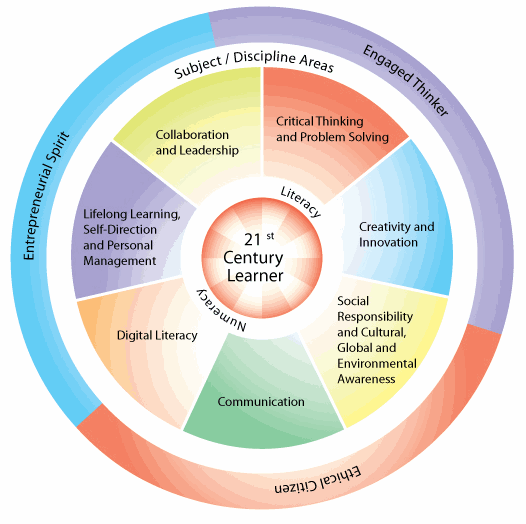
Though I have said in the past that skills like critical thinking, problem-solving, creativity, communication, collaboration, … have always[1] been important, this morning while waiting for a 7:30 flight from Helsinki to Oulu a podcast from one of my favourite programmes – Radio Diaries – beautifully drove this point home. It was a 20 minute story called “Who put the P in NPR?” For those of you who find this unintelligible, NPR is National Public Radio; “a privately and publicly funded non-profit membership media organization that serves as a national syndicator to a network of 900 public radio stations in the United States”. The programme I was listening to was essentially an interview with one of NPR’s founders, Bill Siemering. In that interview Siemering read parts of NPR’s first mission statement, which btw is still given to all incoming employees. The statement read:
National Public Radio will serve the individual, it will promote personal growth, it will regard the individual differences with respect and joy, rather than derision and hate. It will celebrate the human experience as infinitely varied, rather than vacuous and banal. It will encourage a sense of active, constructive participation, rather than apathetic helplessness…
The total service should be trustworthy, enhance intellectual development, expand knowledge, deepen aural aesthetic enjoyment, increase the pleasure of living in a pluralistic society, and result in a service to listeners which makes them more responsive, informed human beings and intelligent, responsible citizens of their communities and the world.
It would speak with many voices and many dialects. The editorial attitude would be that of inquiry, curiosity, concern for the quality of life, critical problem solving, and life loving. The listener should come to rely upon it as a source of information of consequence, of having listened as having made a difference in his attitude toward his environment and himself…
National Public Radio will not regard its audience as a market, or in terms of its disposable income, but as curious, complex individuals who are looking for some understanding, meaning, and joy in the human experience.
If you read it carefully, you’ll see that NPR’s mission was aimed at many the so-called 21st Century skills. The only thing is that NPR was started in 1969, a bit more than halfway through the 20th century. In other words, so much for the novelty and timeliness hype. This emperor has no clothes!
Dear readers: Please don’t jump to the wrong conclusion here. I’m not against the need for acquisition of all of those skills. I’m not saying that they’re not necessary and that they shouldn’t be integrated into the curriculum (note here the words “integrated into” and not “part of”). What I am saying is that almost all of them were of the utmost necessity for a person to function well in the previous century or possibly even in all centuries since the Enlightenment/Renaissance. So please do me, and actually all of us, a great favour and stop propagating them as if they were something new. If they weren’t taught in previous generations of schooling, you wouldn’t be able to do what you normally do every day as teacher or scientist (see my blog from February 2014 – Sorry it’s in Dutch – Als het onderwijs zo slecht is, waarom weet jij het dan zo goed? [If education is so bad: Why are you so damn smart?]). Stop parroting the bullshit being spread and the snake oil being sold about them by eduquacks of all shapes and colours.
Oh, yeah. And what are the skills that are new? An external PhD candidate of mine – Sharon Favaro – summed them up beautifully (Conceição, 2013), namely:
- information management (ability to collect and manage information in multiple formats)
- knowledge management (enhancing communication, information transfer, and collaboration; and
- publication management (the ability to understand the dissemination of knowledge / work and new publishing modes).
Policy makers, academics, researchers, etc: Please take heed! 21st century skills are soooo 20th century.
Follow me on Twitter: @P_A_Kirschner
[1] OK – Not in the Dark Ages.


 Blogcollectief Onderzoek Onderwijs
I totally agree – I often say that these skills could also be called the ‘4th century before Christ skills’. In fact, I think that it is all about the skills that make us unique as humans – which have always enabled us to create new things, to make progress. They are also the skills that differentiate us from computers, robots and artificial intelligence – and will therefor become even more important in the future. This is what I wrote about it (in Dutch): http://operation.education/overwegingen-bij-het-formuleren-van-het-waartoe/
LikeGeliked door 2 people
Mooi gezegd (al was er een periode – de Middeleeuwen – waar zulke vaardigheden een enkele reis brandstapel kon opleveren.
LikeLike
Yeah, hou have a point. But stil, if they are so ‘old’ already, why do we stil seem to have this kind of attention for It? If I take a close look to our educational thinking and our curricula, we still seem to lack the optimal development of these skills. We teach the past, sort of, and hardly seem to be able to teach for an uncertain future (which indeed always was the case). So, maybe the question should be more like: how do we effectively integrate (I totally agree with you on that) these skills in our education? A nice question for the educators of our educators.
LikeGeliked door 1 persoon
Ron,
P3eople are gullible and if it sounds good, they accept it and even propagate it: Hook line and sinker. I’m doing my best here to remain civil.
LikeLike
Dit is op From experience to meaning… herblogd.
LikeLike
Dit is op The Echo Chamber herblogd.
LikeLike
Most of us have short memories, and new generations have to be put on the shoulders of giants before them too. So probably it’s necessary to repeat them, not as old wisdom (as we don’t want to teach for yesterday…) but as something new and daring: much more tempting to think you invented it (‘it’s not invented here’ is a common educational expression for ‘I’m not gonna do it’, isn’t it?).
So scientifically these skills may be old, but strategically it’s necessary to present them as new (including newspeak) to get them adopted. Luckily for conservative educators (or any conservative, for that matter) there’s always a scientist who doubts, so there’s always an excuse to keep doing what you always did.
Btw: I do think I understand your point, this first reaction is about the effects of your position.
LikeGeliked door 1 persoon
My second reaction is about the scope of the skills: it’s all about skills! And indeed, nothing new. First time I read them, I was surprised about the impression that quality of education wasn’t defined in terms of substance: what do young people who are educated to lead us through the 21st century need to know that is different from their ‘ancestors’ in the 20th century? Ofcourse not in terms of well (and static) formulated ‘kerndoelen’ or ‘PTA’s’ but in terms of ‘what do we expect them to be able to cope with (including all connected uncertainties): so developments like innovation, robotisation, migration, rise of new economic powers, growing population, pollution, climate change, sustainability. What do they need to know, what skills would come in handy, what is needed in ethics and consciousness? Would the answer be: 21st century skills?
LikeLike
My third reaction is: NPR’s first mission statement is beautiful in positive humanity. Change NPR in ‘Our school’ and put the statement on the wall of every schoolclass, and in every mission statement of schools.
LikeLike
Dit is op Digidelver herblogd.
LikeLike
Dit is op kadir kozan herblogd.
LikeLike